
Computational Discovery of Intermolecular Singlet Fission Materials Using Many-Body Perturbation Theory
Published in The Journal of Physical Chemistry C, 2024
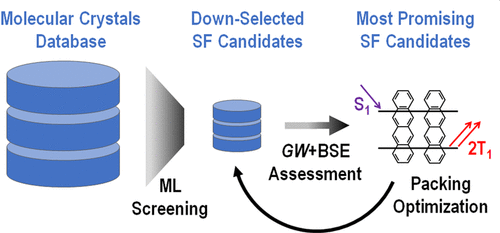
Intermolecular singlet fission (SF) is the conversionof a photogenerated singlet exciton into two triplet excitonsresiding on different molecules. SF has the potential to enhance theconversion efficiency of solar cells by harvesting two charge carriersfrom one high-energy photon, whose surplus energy wouldotherwise be lost to heat. The development of commercial SF-augmented modules is hindered by the limited selection ofmolecular crystals that exhibit intermolecular SF in the solid state.Computational exploration may accelerate the discovery of new SFmaterials. The GW approximation and Bethe−Salpeter equation(GW+BSE) within the framework of many-body perturbationtheory is the current state-of-the-art method for calculating the excited-state properties of molecular crystals with periodic boundaryconditions. In this Review, we discuss the usage of GW+BSE to assess candidate SF materials as well as its combination with low-cost physical or machine learned models in materials discovery workflows. We demonstrate three successful strategies for thediscovery of new SF materials: (i) functionalization of known materials to tune their properties, (ii) finding potential polymorphswith improved crystal packing, and (iii) exploring new classes of materials. In addition, three new candidate SF materials areproposed here, which have not been published previously.
Recommended citation: Wang X, Gao S, Luo Y, Liu X, Tom R, Zhao K, Chang V, Marom N. Computational Discovery of Intermolecular Singlet Fission Materials Using Many-Body Perturbation Theory. The Journal of Physical Chemistry C. 2024 May 1;128(19):7841-64.
Download Paper